
Your 2027 hotel budget: what it might be missing
A second look at your 2027 hotel budget: seven lines that slip through, and how to add AI mid-year with a clear, provable return on investment.

You know how to build a hotel budget. By now yours is drafted, in review, or already signed. This isn't a how-to. It's a second look at the lines that tend to slip through, and the one most 2027 budgets don't have at all.
It's late in the year, but budgets aren't fixed the way they used to be. Wages, energy, distribution and technology are all moving faster than an annual cycle. If there's still room to change a line, these are the ones worth checking. If you've already signed, they're what your first reforecast should catch.
Seven lines that slip through
None of these is hard to budget. They get missed because they sit between departments, or because last year's number got copied forward.
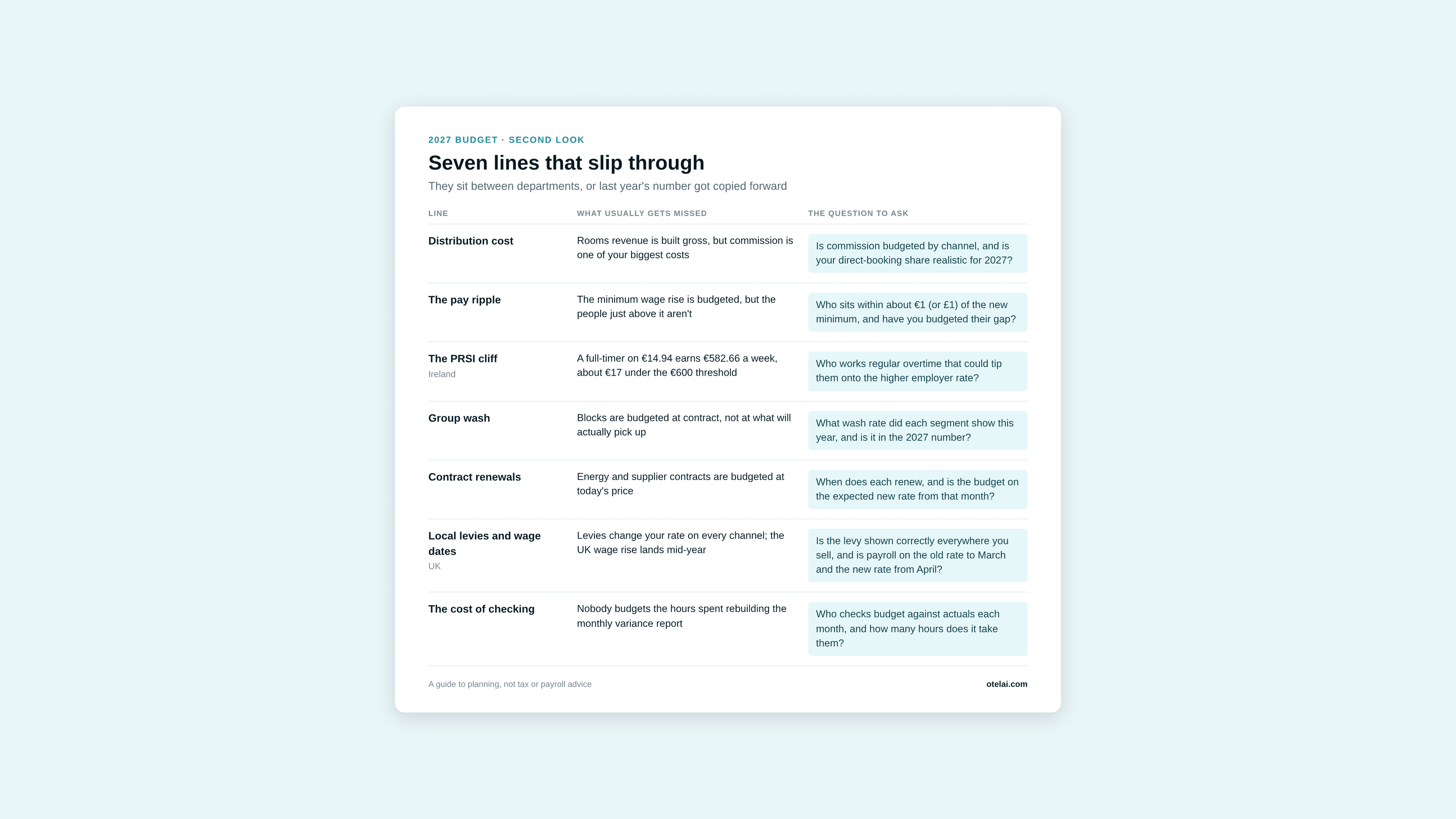
Seven lines that slip through: none is hard to budget, but each sits between departments or gets copied forward from last year.
The 2027 numbers. In Ireland, the minimum wage is due to rise from €14.15 to €14.94 an hour on 1 January 2027, and the employer PRSI threshold is due to move from €552 to €600 a week (KPMG). Our Budget 2027 payroll post works through the ripple, and why efficiency beats cutting hours. In the UK, the National Living Wage rises to £13.21 from April 2027, up 3.9% (GOV.UK). Edinburgh's 5% visitor levy has run since July 2026, Glasgow's 5% levy starts on 25 January 2027, and Welsh councils can opt in from April 2027 (Roommaster).
The line most 2027 budgets don't have: AI
Most hotel budgets have a technology line that's last year's subscriptions plus a bit. Few have a line for AI, because a year ago it still felt early. If your competitors are reading pickup in seconds and catching labour drift in the week it starts, you'll feel it in your RevPAR index before you see it in a report.
If you realise in January or February that you need this, you don't have to wait for the 2028 budget. You need a small, defined start that pays for itself inside the year.
Where to find the money mid-year
- Contingency. It exists for things you didn't see coming. A tool that recovers labour drift or protects rate is a better use than most.
- The cost of checking. Add up the hours your team spends on daily sales reports, pickup, forecasts and the monthly variance pack. That time is already in your payroll. Point the first AI job at it, and part of the cost is funded by hours you get back.
- Your first reforecast. Bring it in as a named line with a payback date, not an overspend.
How to start in the next couple of months
- Pick one job, not a strategy. Choose the most manual, most repeated task: the morning sales report, the pickup report, or the weekly rostered vs actual hours check.
- Name an owner and a measure. One person, one number: hours saved per week, labour variance caught, or rate actions taken.
- Run a four-week trial on your own data. Long enough to see a full reporting cycle, short enough that a "no" costs little.
- Decide at week four. If the measure moved, extend it to the next job. If it didn't, stop.
What goes in the AI line, in more detail: The one line item every hotel needs in their 2027 AI budget. For a week-by-week plan, see the Practical AI strategy guide for hotels.
What return to expect
AI pays back in three ways in a hotel: time back from manual work, cost caught earlier, and revenue protected or added. Budget the first with confidence, the second with a range, and treat the third as upside.
Here's how that looks at Harbour View, a made-up 60-room hotel at 75% occupancy and a €150 average rate. Swap in your own numbers.
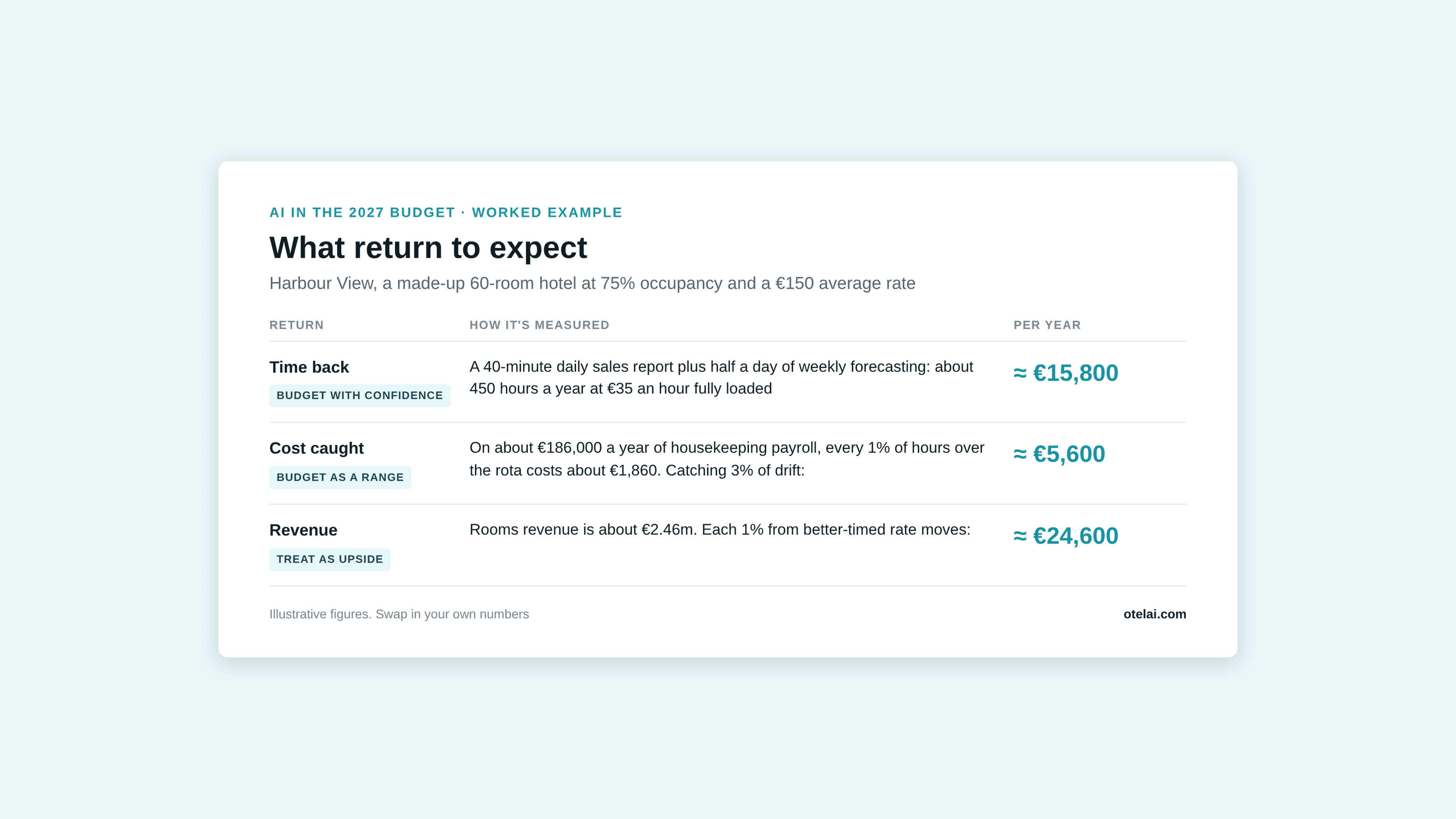
What return to expect: budget time back with confidence, cost caught as a range, and revenue as upside.
Time back alone often covers a first-year tool cost. The revenue line is where the bigger return sits, but it takes longer to prove, so don't hang the business case on it.
What hotels using Otel have reported
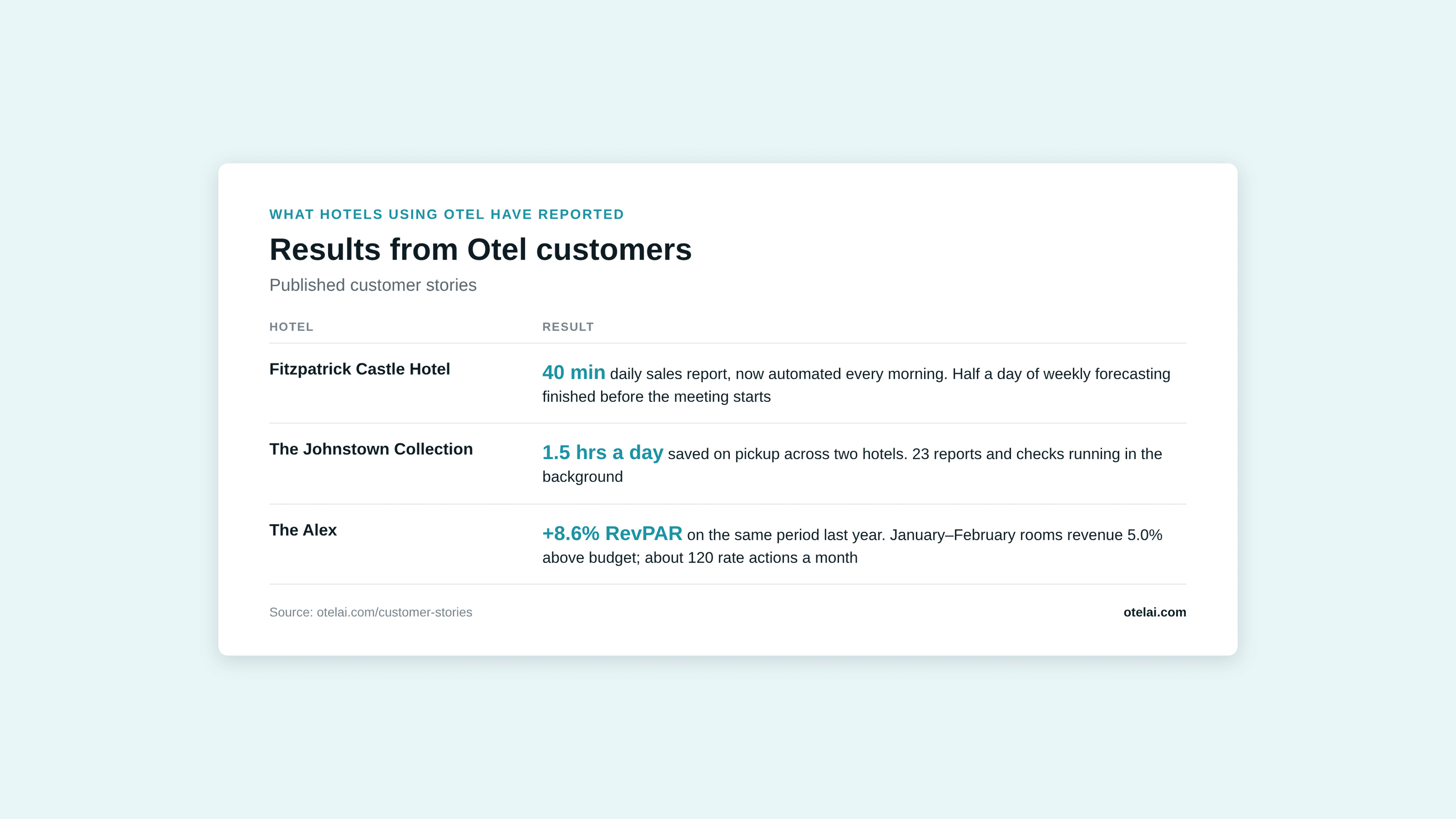
Results from published Otel customer stories.
After sign-off: the budget is the easy part
From January you'll have two numbers for every month: the budget you signed, which doesn't move, and the forecast, which does. Keep both. The gap between them is the story you'll tell the owner all year. Weekly reforecasting for the next 90 days and monthly beyond is a good rhythm when things move this fast.
The hard part is that the actuals don't live in one place:
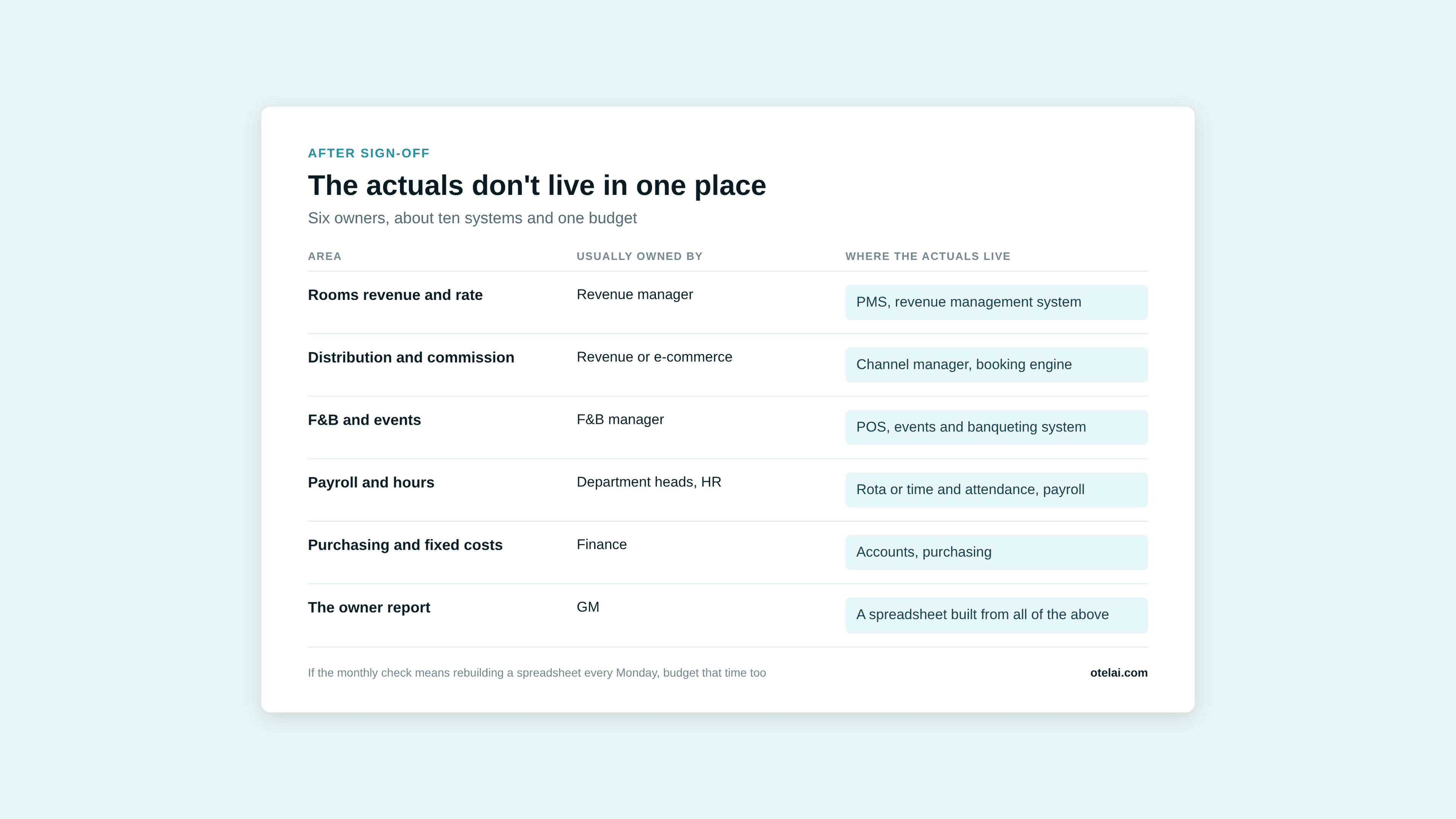
That's six owners, about ten systems and one budget. If the monthly check means someone rebuilding a spreadsheet every Monday, it's the first job worth handing to AI, and the easiest return to prove.
How Otel fits
Otel connects the systems your hotel already runs, including legacy ones with no API, and reads them as one hotel. Nothing migrates and nothing gets replaced. It reads your trading history from the start, so the first job can begin straight away.
It stays quiet while everything's on budget. When a line drifts, such as bar labour over target for a third day or a group block still at 0% a month out, it flags it to the person who owns it, with the reason. You can ask any number where it came from, and nothing changes without your yes.
If 2027 is the year you add AI to the budget, start with one job on your own data.
Continue reading
Related articles

Budget 2027: protect the service, not the spreadsheet
Ireland's minimum wage rises to €14.94 in 2027, but the real payroll cost is higher. How hotels can absorb it through efficiency, not cutting service
 Tadhg McNealy·4 Nov 2026
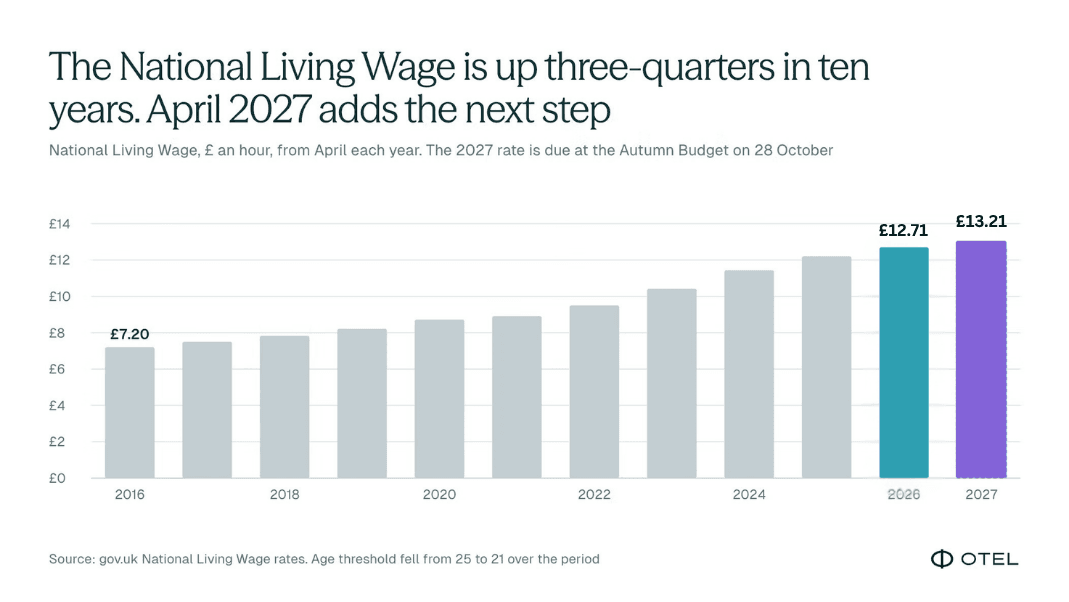
Why the UK 2027 Living Wage Hike Won't Break Your P&L (Rota Drift Will)
The 50p Illusion: Why Rota Drift Costs Hotels More Than the Living Wage Rise. Otel AI unifies your PMS and scheduling data in real time, catching payroll drift as it happens and putting decisions directly into your managers' hands.
Tadhg McNealy·28 Oct 2026
The practical AI strategy guide for hotels: the 2027 edition
The practical AI strategy guide for hotels is out as the 2027 edition. It answers one question: where do you start? Find the work, choose one use case, prove it in shadow for four weeks, then decide from evidence. Ten print-ready templates come with it.
Tadhg McNealy·22 Oct 2026