
The practical AI strategy guide for hotels: the 2027 edition
The practical AI strategy guide for hotels is out as the 2027 edition. It answers one question: where do you start? Find the work, choose one use case, prove it in shadow for four weeks, then decide from evidence. Ten print-ready templates come with it.

The practical AI strategy guide for hotels is out as the 2027 edition. It answers one question: where do you start? Find the work, choose one use case, prove it in shadow for four weeks, then decide from evidence. Ten print-ready templates come with it.
Most hotels are walking into 2027 planning with an AI line on the list and no clear idea what goes in it. That's the gap this guide is written for.
What we keep hearing
All year we've put the same four questions to hotel audiences: general managers, owners, revenue leaders, IT directors. The answers barely move from room to room.
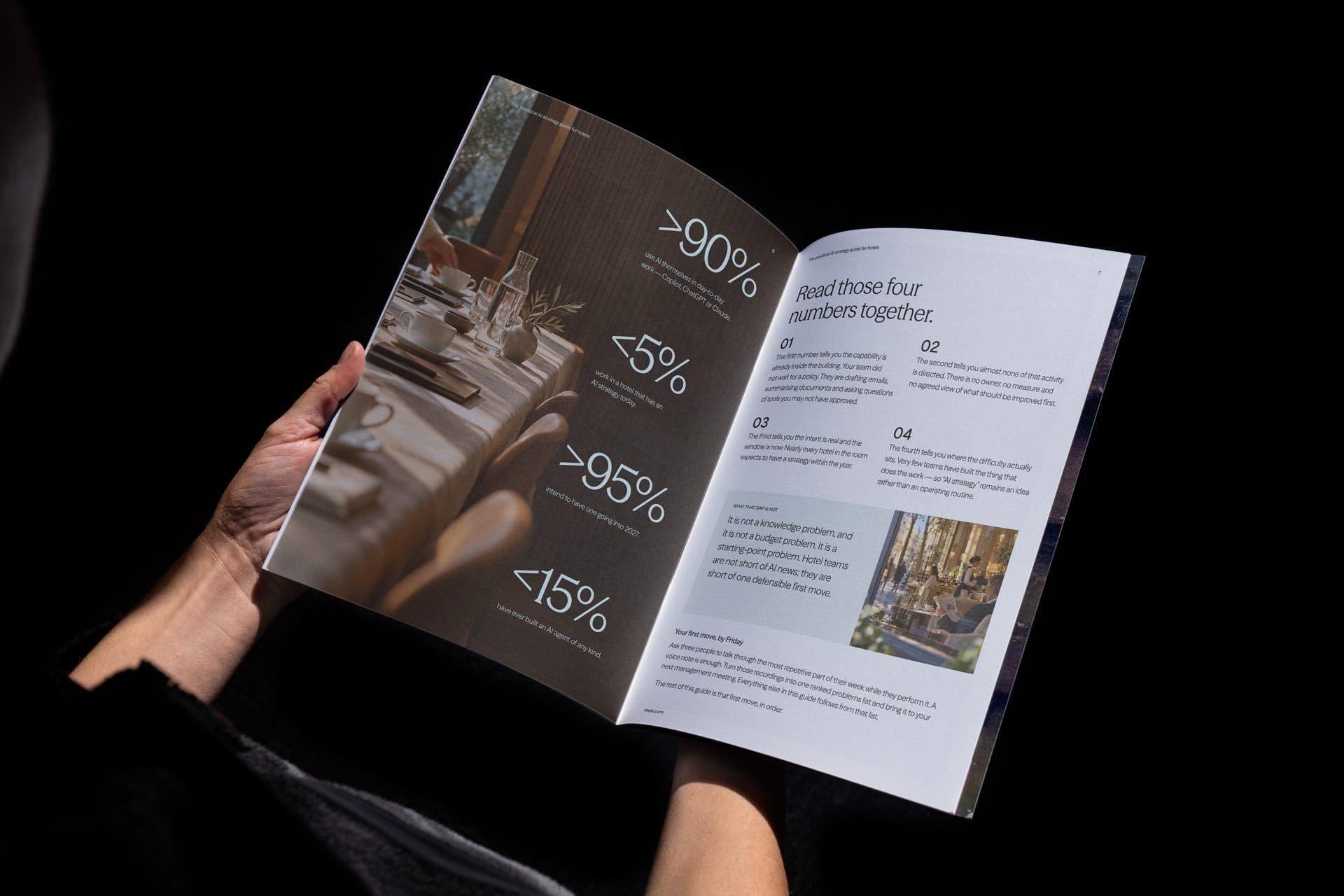
Those are hands in the room at our own sessions, not a formal survey. But the shape is hard to argue with. The tools are already in the building. Almost none of it has an owner, a measure or a first job.
The wider research points the same way. Canary Technologies surveyed 400+ hotel technology decision-makers in early 2026:
Source: Canary Technologies, Navigating AI: Hospitality Shifts From Exploration to Execution, March 2026.
| Canary Technologies, early 2026 | 400+ hotel technology decision-makers |
|---|---|
| 51% | are piloting or have already deployed AI today |
| 82% | expect their use of AI to increase within twelve months |
| 85% | will put at least 5% of their IT budget behind it this year |
Canary Technologies, early 2026
51%
400+ hotel technology decision-makers
are piloting or have already deployed AI today
Canary Technologies, early 2026
82%
400+ hotel technology decision-makers
expect their use of AI to increase within twelve months
Canary Technologies, early 2026
85%
400+ hotel technology decision-makers
will put at least 5% of their IT budget behind it this year
Meanwhile a 2025 survey of 400 UK and Ireland hospitality operators, by CGA by NIQ for Access Hospitality, found that almost three in four believe the technology they already own could be used more effectively.
So spend is rising, and the tools already paid for are under-used. That's not a technology gap. It's an operating one.
What's in the guide
It's a method, not a trend report. Four steps:
- Find the work. Three people talk through their most repetitive week, and you rank what you hear.
- Choose one use case. Score it on frequency, value, data access, definitions, testability and ownership.
- Prove it in shadow. Run it beside the human process and log every call and every error.
- Decide from evidence. Stop, revise, continue or expand, on measures you agreed before you began.
It comes with ten print-ready templates, T1 to T10, from the work audit to an 18-point readiness check and a weighted 100-point supplier score. Fill them in against one real workflow in your hotel, not a hypothetical AI programme.
Your first move, by Friday
Ask three people to talk through the most repetitive part of their week while they do it. A voice note is enough. Turn those recordings into one ranked problems list and bring it to your next management meeting.
That's a week's work, and it'll tell you more about your 2027 AI line than a month of demos.
Continue reading
Related articles

Personalisation That Pays: The Version Hotels Actually Need
Everyone's selling hotels personalised guest experiences. Almost none of them ask whether your team's own systems understand your hotel first, and that gap is where the real revenue is leaking.
 Paul Ryan·25 Aug 2026

Vibe Coding and Hotel Operations: What It Means for Your Team
Vibe coding isn't just a developer trend. It's for hotel ops, letting revenue managers and GMs describe what they need in plain English and get it done.
Paul Ryan·6 Jul 2026
Hotel AI Skills Gap 2026: Why Technology Isn't the Problem
Most hotels have the tools. What they're missing is the capacity to act on their data. Here's what the AI research from BCG says, and what to do about it.
Paul Ryan·24 Jun 2026