Paul is the CEO and co-founder of Otel AI, the operating advantage for hotels: every system a hotel runs, in one view you can trust, with the work done on top. He puts the same questions to every room of hoteliers he speaks to, and the answers are the reason this episode exists.
Watch the full conversation with Paul and Floor.
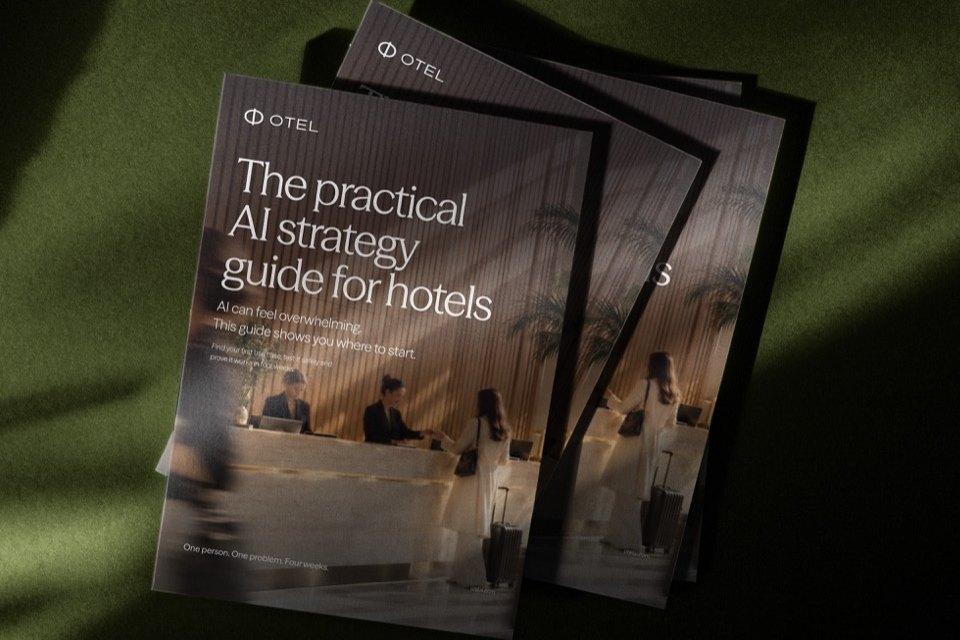
A hotel AI strategy is a plan for where AI takes work off your team and where people keep the final say. Start small: pick one repeated job, like daily pricing or morning reporting, connect the systems it depends on, and have AI prepare the decision while a person approves it.
About this episode
Two weeks before this recording, Paul asked a room of fifty general managers who was using AI. Every hand went up. Who had an AI strategy? One. Who would have one going into 2027? None. The answers around the room were all the same. “We don’t know where to start.”
That’s the question. Floor ran technology for Accor, Mövenpick and Jumeirah, and now advises and invests in the companies changing how hotels are run.
They get to the practical version: why a strategy for its own sake is the wrong first move, what the big brands are about to lose and independents stand to gain, where the hours and the money in a hotel actually go, and one thing to start this month with the team you have.
- 50 GMs. One AI strategy.
- Distribution and revenue management get disrupted.
- AI isn't a strategy. It's tactics.
- I tried the big brands' ChatGPT apps.
- AI won't be 100% accurate on day one.
- Your brand isn't trying to make you efficient.
- The best time in history to be independent.
- Three costs AI can take out of a hotel.
- Hotels spend 1% on tech. Banks spend 15%.
- Your night audit is half a salary.
- Who owns your hotel's data?
- Don't put someone in charge of AI.
- One thing to start. One thing to stop.
Lightly edited for reading.
Paul Ryan
Two weeks ago, I stood in a room with 50 general managers and I asked the question, who's using AI? And every single hand went up from using ChatGPT, Claude, Copilot. I then asked the next question of who has an AI strategy? And that one hand was put up in the room.
My next question was: Do you have an AI strategy going into 2027? And again, not one hand was put up. And the common theme was we don't know where to start. Everyone's using AI today, but nobody has put structure on it.
And the gap is what we're we are really going to focus on for the next half an hour. My name is Paul Ryan. I'm the CEO and co-founder of Hotel AI. It's an AI platform that does the work in hotels.
We plug into hotel systems you already have. And our mission is simple: to give your team back time to spend with guests and not spreadsheets. With me is the main man I ring when I want to be told I'm wrong, Flor Bleaker, the ex-group CTO of Accor, Malvinpick, and Jamara. These days he advises and invests.
He's been around hotels since the beginning. And if anyone can tell you about what hotels should actually be doing about AI, there's no better man. Floor, you're very welcome. I want to jump straight into it if that's okay.
So there's obviously been a lot of noise over the last 12 months. Around AI and hotels, from guest facing apps to AI discovery and everything in between. My first question really is: how should a hotel actually think about deploying AI today?
Floor Bleeker
First of all, thank you for having me. Really great to be here and always fun to work with you and the team. We're gonna unpack a lot of things, I guess, and the main question what was on the mind of your GMs is where do we start? I think we need to take a few steps back before we answer that question because there's a lot that should happen before that and it goes all the way from the strategy that hotel groups have down to what can be done today in a hotel to make life better.
Well we can obviously talk for hours about this, but AI is not something you build a strategy around in my opinion. It's a little bit like customer service or doing the right thing. AI is gonna sit in everything we do. And AI will be the catalyst of a lot of transformation in the world and also in our industry.
And at the same time, AI can make your life today a lot easier and you need to work on all these things at the same time. One maybe let's start all the way from the top. If you look at the big hotel groups today, the big brands, They provide services to hotels like distribution, it's very important, loyalty programs, revenue management. And those are areas that may be completely disrupted with AI.
There might be no distribution anymore or a very different type of distribution. Revenue management is very likely to be done by AI agents, it's already done by AI for a big part, but in the future That might be done by AI agent altogether. And that means that those business models may be completely disrupted. So if you're in a hotel group, you need to think about that and say, okay, what do we need to do different in order to stay relevant in the future?
If we cannot provide those services anymore, maybe something else needs to come in between. And that is has nothing to do with technology. I mean, you cannot say, hey, we need an AI strategy. You need a business strategy that will deal with whatever disruptions are coming your way.
But if you then take that down to, for example, an individual hotel where you say, Okay, what can I our AI strategy be, maybe the focus should be more on what you can do today and not what will disrupt it in the future. The good news is I think if you're an individual hotel that you will have access to the same tools And the same platforms as the big brands have. So the big brands, you don't have to join a big brand anymore in order to have good distribution, for example, in the future. Today that is still very much the case.
But it's very likely that in the future that you don't have to do that anymore. So that is one worry of your mind. But then there is a million things in a hotel that can be done better with tools that exist today. And I wouldn't call that a strategy, that is more like what Tactics.
So shall I deploy whatever I'm doing today? I still want to do today. I want to give great customer service. I want to be efficient.
I want to make money. I want to give my teams the opportunity to interact with each other and with guests. That is all the same. But now you have the tools to actually take a load off of their shoulders and do that much better.
So I would say you need more of a strategy around the tactical implementation, so call it tactics of current tools. And there's many available around, including the ones you develop, that can de be deployed very quickly and very easily and give you one thing that you can do better. So I think to answer your question is a bit of a long answer, but maybe the gist of it is start small, look around you, see what you can do now, find a partner and just do it. And then you will make some improvement.
Paul Ryan
I don't know if I've like oversimplified it, but like there's use cases that keep coming up, especially with like say general managers. And there's a general manager I met about two weeks ago and he's actually part of a global brand and he walked me through his morning routine and he says he comes in at eight AM every morning and he's got about eleven tabs open And he needs those eleven tabs open to sort of piece together what happened yesterday, what's going on today, and do I have a problem in the future? And it kind of gets about half ten in the morning or ten o'clock, and that there's two hours gone where he hasn't spoken to his team or spoken to his guests. And I'm in my mind, that's a repetitive task.
There's systems that he's logging into or data that he's searching for that is the perfect use case for AI. So when someone asks me, you know, how should I think about an AI strategy? I kind of say a starting point to get people into a room, you know, get a general manager into a room, a revenue manager in a room, and like record it. Like, you know, everyone has a phone, they have voice memos, and map out what are those people doing on a daily, weekly, monthly basis that's repetitive.
And take that recording, upload it into a model, and ask it to like automate, you know, or to rank in terms of amount of hours spent on certain tasks, and that's like the starting point for an AI strategy and then really determining okay which use case are we going to tackle this month. We have those three people that we brought into the room. That's my name, my AI group. Can we solve those use cases either with existing tools or maybe search the market for new vendors?
I don't know now is that overly simplify have I oversimplified it but
Floor Bleeker
No, I agree with you that this is a very good thing to do. And it's a little bit like it was probably before you're born, we had business process improvement. And it's a little bit like that on steroids. But it's not a strategy.
If you talk strategy, it's a long term, big objective transformation. This is doing what you do already, but doing it better. And I think you're absolutely right that there's so many opportunities to do that now. We're not particularly good at it in hospitality either.
If you look at the way we run a typical hotel with big XCOMs and lots of processes and lots of manual work and lots of bureaucracy. I mean there's we're absolutely ripe for this. So I think your approach is very good and I think everybody should do that in whatever job they are and sit back and think Okay, what am I actually spending time on the whole day? What adds value?
What doesn't add value? And then what can be done by tools that are available now and that may not have been available in the past. So I think that approach is really good and it's a fun exercise to do as well. I guess to sit in a room and what you said, just record what you're doing the whole day and then analyse that later and find these nuggets.
It's a fun exercise to do and I think it's a really great way to find these improvements and start somewhere because that is the most important thing. If you don't start them, you're gonna wait until the big brands do something or big tech replaces distribution. Yes, it will happen and it will happen in the next three to five years, in my opinion. But you can do stuff today that gives you advantages today.
So I think it's the right approach.
Paul Ryan
I think i again, something we hear is, you know When hotels tell us about maybe their problems or where they're spending time and when they say it out loud, you know, they then sort of realize, well, actually this really isn't efficient. And it's just it's the way it's always been done. And hotels they don't know what they don't know, but having it sort of in a page, like we did it with a hotel group recently and we mapped out seventy-two hours a week for one hotel that's been spent on like really repetitive reporting insights analysis tasks. And when you Put that out across the year, like it's a tremendous amount of teams' time going into something that can now be used doing yeah, using AI.
I want to jump to the next question, okay? Again, you sit on boards and you've been involved in like big tech implementation projects, and maybe with AI also too. But when it comes to deploying tech projects or AI deployment, have you seen areas where AI deployment has gone wrong?
Floor Bleeker
Okay. Yeah, so first like if you look at tech in general, I think there's stats about this and I'm not gonna quote this right, but there's definitely more tech projects that don't meet the objectives than the ones that do meet. And part of the reason is that there's a lot of over overpromising going on by vendors internally, in discussions with the board. So the expectations are very high, so it's very hard to meet those expectations, even though maybe a project might be successful or it might be improving the situation, they're not as big as they were promised to set out.
And this is not something that is related to AI that goes back since I started my career. Very, very hard to meet these expectations. And on top of that, tech changes quickly, so by the time you implement something Since the time we started, things have changed. And then there is a lot of change management that often goes wrong as well.
So the well technical implementations often work well and are or are easy to resolve if there are issues. What is not easy is the adoption, people actually using the system the way it's supposed to be, and then people wanting to use it because if they don't want to. Even the best tech in the world can fail if people don't want to use it. On the AI side, I wouldn't say failures, but what I see around me now is a lot of noise coming from brands and vendors and they all say we have AI, we just deployed this, we just deployed that.
And a great an i example of that is an I don't know if you've seen it, but it's actually quite funny. A few big brands this week announced that they have ChatGPT apps. So that is sort of an add-on to Chat GPT. And that with that add-on the interaction with the brand and should become easier.
So I thought, wow, this is cool, it works with an MCP, so maybe we can finally make a hotel booking. Through ChatGPT. That would be a great use case, obviously. You search for something and then so first of all you need to search for the specific hotel from the specific brand on a specific day.
So pretty much like any sort of booking engine. But once you do that, it looks very nice. You have the interaction. And I tried multiple brands, so this is not one brand.
And then once you're ready to book and you say, Yeah, book it, ChatGPT actually gives you a link to the booking engine and you have to start again. So it just links to the hotel website and then you have to and it even tells you please make sure to put in the right dates and the right hotel when you search. So I think in my opinion that's a big failure. That was just a waste of time and money.
But they all make it sound like they did something incredible when it's not. I think there's absolutely no value other than the PR value that they make out of this. I don't believe anyone will actually book that way. But so this is a very recent one and there's many.
Having said that, it's easy to sit on the sideline and say, hey, this was a failure, that was a failure. I know how hard it is. And I also know that you need to try a lot of things until you find that one thing that actually works very well. So I wouldn't discourage anyone from doing it, but since you asked.
But while we are talking, y you're a start up, or you have been. You must have seen some major failures in the early days of your project as well. Is there not something you can share that is
Paul Ryan
Yeah. Major failures, Jesus. I think for us w one thing that is like Probably needs to be more spoken about candidly by vendors is that AI can't do everything and anything, and maybe there's a perception with hoteliers that when they get an AI solution that it needs to be 100% accurate on day one. And it's just simply not possible for multiple different reasons.
And it's not to say that the data's not accurate, it's like context. Do you know that piece? So I think when we were starting off, we gave our tool to some of our early customers and we didn't do that kind of customer discovery to really unearth like that context piece. So like to give you example, you know how a hot how a hotel would define like on the books revenue is different to a hotel down the road.
Some hotels include no show revenue, cancellation revenue. So like I said, we made a mistake of just giving our tool and then a couple of revenue managers might ask a question and it might be 80% accurate, but then they're like, well this isn't accurate And now I'm not going to use this because you know I can't trust it. When in actual fact it's the last mile is like context. So really spending a bit of time either with your vendor or internally like mapping out what context is, and it's really just definitions.
Like another example is we brought on a hotel and it did a big refurb last February, and its whole product is different. But like AI doesn't know that, it just has access to all your data, but it doesn't know that you spent five Six million on new rooms, so then your rooms have a more premium offering, it should sit higher in your comp set. All these nuances, just AI isn't there yet. So I think between the vendors doing a better job at capturing that context and then hoteliers being conscious that AI isn't going to be 100% accurate, but just keep being curious, keep talking to it, keep talking to your vendors, then will you get the real benefits from it, if that makes sense?
And I don't know whether you'd agree with that or not.
Floor Bleeker
Yeah. And I think what you're describing is the classic data problem that we've had for years in the industry. Before AI we had BI and the BI was completely relying on the data that we got. And it's incredible if you look at a few different hotels that you want to consolidate and do a report for region or city, how different they their definitions are and It's simple things like what is included in a ref bar, do we include the out of order rooms?
Do we include the comp rooms or not? And some do and some don't. If you're from England, do we call it UK or Britain or England or and even those things are not standardized well enough. And I think that makes it made it very, very hard to do automation in the past.
But AI should make that easier, right? I mean it is i these things they AI should be able to learn and while it made makes mistakes, it should learn from those mistakes and once you correct them, mistakes should not appear again. And it should be easier to include, let's say if you're a small chain or if you're a big chain and you've done well one well and you add the second hotel and you add the third hotel, the fourth hotel should be a lot easier because you've seen most of these mistakes and A AI should remember those and apply it.
Paul Ryan
I totally agree. And I think it's more I suppose what I'm trying to emphasize is people using AI just to c continue to be curious. Do you know? Don't think this is a one hundred percent accurate day one solution.
It's that curiosity will Eventually combat compound AI will learn. I think what's funny, like we see it, we sometimes analyze our usage on our chats and hotelliers are hands down, the most polite people that use AI, they use please always remember this and if you don't mind and apologizing and everything. And it's just it's so funny to see it on a weekly basis. It's in the AI,
Floor Bleeker
To the AI. Yeah.
Paul Ryan
Yeah, exactly. Exactly. Very polite people.
Floor Bleeker
We are a people business, so and that's good. And who knows, maybe these a these AIs will develop some conscience in the future and they will remember, I'll tell you. So
Paul Ryan
Don't say that. Don't say that. That's scary. I wanna ask you one other question.
So, you know when you're involved with say I know you work with a lot of some big brands and you sit in these boardrooms and when these groups say I have like an AI strategy, like What's actually happening? And in your view, you mentioned there around some of the brands announcing these plugins and ChatGPT, and some of it's a little bit of noise. Like in your view, are brands materially ahead of say independent hotels or in terms of strategy, in terms of implementation, or is everyone kind of just starting off? And you know, for a general manager or hotel owner that owns two or three independent hotels, are they two years behind the curve?
Or yeah, what is your Yeah.
Floor Bleeker
Yeah, so I think what you need to realize first is that a hotel brand is a very different business model than a hotel. A hotel brand is asset light and what they sell services to hotels. So a hotel brand sells loyalty or distribution services and sometimes other services like revenue management or some technology services. But they are not very interested in what happens inside a hotel.
It's very driven by top line, so the revenue of a hotel because that's where the management fees and the franchise fees are paid from. It's very driven by distribution because there's a distribution fee that is paid. It's not very driven by operational efficiency, for example, because that is not a direct benefit to hotel brand. So I think If you realize once you realize that a hotel, individual hotel is not competing with a hotel brand.
They're looking at different things broadly. The good news is, I think, and I just mentioned that, is on the operational efficiency side and the guest experience side, a lot is going on and it's driven by vendors that use AI and it is available to everyone. This is not just available by hotel brands. And I think th there th they should not worry, there's lots they can do.
And I think if they're finding their niche, so we're talking about the independent or smaller hotel chains, if they're finding their niche, what they want to do. I wanna best in be the best in customer service, I wanna be have the most efficient back office, I want to reduce the cost of my front office, whatever it is, th they can just start now and work on that and they don't have to wait for a brand to do that or for their whatever franchise partner to come up with a standard for that because that's not their focus or at least not yet. Having said that, I believe, and this is just me talking, not based on any experience, that the focus of the big brands will shift a little bit because they will see that some of those money makers for them now will slowly disappear. They will democr democratize.
And so they need to come up with something else. The obvious thing to look at is the experience of the hotel and experience of the guest. Make hotels more efficient and make the guest experience better. And I think that would be better for everyone if we do that.
That's that would be a great development. But that might be a few years ahead as well. So no, I think the difference is just that it's different the business models and definitely nobody should Worry, it's the best time in history to be an independent hotel now. You can write your own story, and there's tools out there that are not expensive that can help you achieve that at a not so high cost.
Maybe it's worth mentioning, and you may have heard me say that before, but margins of hotels are very, very slim. And the reason for that is that there is a big chunk of money going to distribution. So a hotel if you get a hundred dollar room rate in probably twenty to thirty dollars of that goes to an OTA, a brand, a technology partner, a payment partner. They all take a percentage and but if you add them all up it's a big chunk.
And then there is the cost of having all these employees. I was talking about the big XCOMs, very heavy on staff. Which might be another thirty or even forty percent, then there is energy, and then there is all the rest, including the tech that they need to deploy to do better, which is a very small percentage. And then they're lucky if they're lucky they have a profit of a very small percentage.
This is what these hotels are dealing with. And I think their best time is to come now because if you look at the AI And the technology advances that are being made, those big cost elements, they can be reduced now. You can reduce your redistribution cost if agent to agent bookings come into place, or there's alternative ways of booking using AI that will be cheaper. The labor cost itself can go down.
I mean there is lots of including the stuff that you guys are doing. It's taking out a lot of unnecessary work that is happening today that is not adding any value to the guest experience or to the profit of a hotel. That can be reduced. Energy cost can be reduced by i implementing smart systems.
So if you take a couple of percentage points of each of those, suddenly the profit outlook looks a lot better, even if you invest a little bit in more in technology.
Paul Ryan
Do you see on the ground groups now starting to maybe increase their technology spend? 'cause like you mentioned there, it's a small slice of the overall percentage and what's your views on that? Do you think you know hotels spend enough on technology and do you see that budget kind of increasing the more AI can bring efficiencies to the hotel, or what's your thoughts on that?
Floor Bleeker
So again there's two different things. You have hotel groups. They have their IT budgets that are reasonably high. They have a lot of people in tech because part of a hotel asset light group is being a technology provider.
So they have big distribution machines, big loyalty machines, and they cost a lot of money, their digital presence and all that. So I think as a percentage of revenue in the hotel group, so on the in this call it the head offices. The spending is quite high. The problem is on a hotel level.
In a hotel you typically the spend is one to two percent. While if you look at comp competing or no sorry not competing with other industries, maybe like retail or banking or anything else, it's more than the one to two percent. But sometimes it's up to ten to fifteen percent of revenue. And that makes a huge, huge difference.
I think one of the questions that is asked most during these panels on the big hospitality tech conferences is why are we so slow in innovating and implementing new technologies in this industry? Well, part of it is our own fault. We don't spend enough money in it. So there's a lot of answers to this and it's a complex question, but definitely part of the problem is that one to two percent.
If you are a and startup like yourself, and you do a great job and you build a nice tech, you see that it is very hard to sell it because it's long sales cycles, complex environment. But then you also see that we're not very willing to spend money like in other industries. So you need to do with a very, very slim margin and that makes it hard for you to invest and to innovate as well. So it's a an endless cycle that continues.
So In my opinion, it's very important that it one to two percent goes up, even two to three percent, it's doubling it basically. And then you will make the money somewhere else. It's very easy and maybe we need to step out of that. We do the things we've always done and we do it the way we do it a little bit, and start looking at what technology can do for us.
And if you have a night audit that takes you four hours a night. Every night. That's a half an FTE to run and which is purely bureaucracy and processes that can be automated. If an AI can come in and automate that you literally save half an FTE.
That's a lot of money to invest back into the technology. And there is many, many like that. As you said, sit your people down and everybody can come up with a couple of hours a week that they can save if things get automated. So I think unfortunately I've not seen it.
And I s we are have a very bad habit of squeezing our technology vendors like to the max and often they squeeze until they break because they just want to have the business and then hope that will accelerate their growth, which often doesn't happen. So we're doing it to ourselves so I think Very, very important that we make a little bit more money available for these things.
Paul Ryan
I wanna maybe touch on that a little bit more because I know in June at high tech, so for those not aware of what high tech is, it's probably one of the largest hotel tech conferences globally. So at high tech in June in San Antonio, you held like a closed door session with some of the global CEOs from like Oracle, Muse, and a lot of CTOs and C suite from the big brands. What was discussed in that room and yeah what were the key themes coming out and where was their misalignments from the different sides
Floor Bleeker
Yeah, so it was done by Hospitality Net. So Hospitality Net we took a share in that. And as part of the deal it was not just money, we also wanted to get involved in maybe making the industry a little bit of a better place through that platform. And one of the things I thought would be nice to do is for the first time sit down CEOs of PMS companies.
With a panel of CIOs, CTOs of the big brands. And they all showed up. This it was amazing because it was closed door and it was yeah, I was and they're
Paul Ryan
I would have loved to have been in that room as a fly in the wall, yeah.
Floor Bleeker
All super nice people and very open. But when you see them on stage or you have these public meetings, they often go by the script that the PR department has given them. And we had Chatham House rules, so everybody was able to say what they want and we would not attribute it to anyone. So that is what happened in that room.
And it was a really nice conversation. People were super open. But one of the things I think we all agreed with is that we're not an industry that is very open to startups and to therefore to innovation because everybody agreed that innovation is not coming from the big brands. It's not coming from the big PMS companies but it's often coming from smaller companies, sometimes from outside the industry, sometimes from in the industry that were established out of frustration because there was something that wasn't working and they came up with a solution.
For them to bring that to market is very, very hard. And I we had a good discussion about that and we agreed to actually have a separate discussion with the same group on that topic to see what we can do as an industry because in the end everybody wins. Problem is that the big technology brands, they are trying to protect what they have, so they make it difficult with integration and interfaces. The big hotel companies, they really want to innovate, but they're very bureaucratic in the way they're set up.
And they're often asset light, so very hard to make big investments that need the support from every hotel around the world, because we rely on a lot of owners of those hotels. So there's lot of good excuses for not doing it. But in the end everybody loses because these The startups that have good ideas and solve real problems don't really make the light of day in the end. So that was one thing that was discussed there that was really interesting.
The other one that I found very interesting was the data ownership, because of with AI that becomes a huge topic, like where does the data come from, who owns it, what can we do with it, what can we not do with it. And we ask anonymously to them. Who owns the data that sits in the PMS? It's not a very complicated question.
We have PMSs for years and years that should have been worked out by now. But the answers were very telling. We basically had different answers from the different groups. One said it's the PMS company that owns it, the other one says it's the hotel brand, and someone else says no, it's the hotel owner, someone even said no, it's the guest who owns it.
So was absolutely no agreement in that room with the key decision makers on data in our industry on who owned that data. So it's a little bit of a side topic, but it was very, very interesting as well. Yeah. And then
Paul Ryan
That's concerning or scary.
Floor Bleeker
And then maybe the last one that was funny. I knew it instinctively, but if you asked this the tech strategies of the CIOs and the tech strategies of what the CEOs of PMS companies are building, they're very, very different. So and this was anonymously on a screen. The CTOs they want to save money.
So then a lot of their strategies on tech are deploy tech that actually saves them costs. But the PMS companies are building for guest experience, which is not exactly the same most of the time. So they and that was very interesting. So I think there were some side conversations after that may change this, but they have a very different starting point when they develop stuff.
Paul Ryan
The point you mentioned around innovation and the industry maybe being less receptive to let's call it opening up and maybe coexisting with startups like ourselves. Like we see it every day when like our platform essentially is integrating hotel systems and there are some that are very forward thinking and are very keen to say, you know, let's coexist, let's work together, and then there's others that are more no there's a cost of this you know and it's what it's either it's bared by the startup or by the hotel which ultimately again restricts startups from building and scaling and then also suppresses hotels from more optionality Do you see or an opportunity where we could potentially coexist and there's more of a collaborative relationship whereby I don't know, maybe there's like partner programs for startups where maybe they don't get all the revenue they want day one, but as startups like ourselves, scale, we scale they scale with us and they can both benefit because There's so many conflicting strategies with different vendors that we see. Yeah, what are your thoughts on that?
Floor Bleeker
No, no, absolutely. A couple of things. I think first of all the cake is large enough for everyone. Travel is growing, even in the worst of times, we're still growing and there's new markets coming on board every year.
We have the Chinese starting to travel, we have Africa starting to do international travel, and th there's so many the population itself grows. Maybe even with AI that people get more time One thing that I think will not disappear anytime soon is travel. People want to see each other, they want to experience new places in real life. So I think there's enough for everyone.
Also, I mean you travel yourself, the travel experience is horrible if you compare that with any other experience, service experience, whether it's retail, whether it is interacting with your bank, travel is just very, very bad. Renting a car. Checking into a hotel room, it's all like it's not nice. There's very few places where you think Well, that was a nice experience.
I'm talking about all the necessary stuff that needs to happen. Obviously it's nice to see a sunset in a new place that you haven't been yet. But the everything that sits around it, that there's so much room for improvement. And I think that's also why you see many coming out of the industry and say, Hey we can do this better and then they find out that it's actually very hard to implement.
It's a different question. So I think th there's enough for everyone and there is enough opportunity to make it better. It's not great at the moment. So there's enough then why is it not happening?
So I've had in my past jobs multiple times actually that I landed a job and there was an innovation department. And I think that is the worst thing you can do, having an innovation department in a big company, having a couple of girls and guys sitting in the basement dreaming of great ideas and then thinking that it will be implemented. That's not how innovation works. So in my opinion I've closed these departments straight away because that they really don't produce anything that you can put into action.
Innovation is part of everybody's job. It's a culture that you need to foster. And AI is very much linked to innovation because AI it's a buzzword, but it is really a catalyst for doing things differently and opening new opportunities, and that is innovation. So AI is very much part of that.
So I also don't think that you should have someone in charge of AI in your company. Of course, there need to be technical people that understand how to manage data and how to implement things and how to keep it secure and all that, but AI should be really part of everybody's job. And then if you're in a big company, it's very hard to break the existing processes because it's not just you, you need to do things different, but often many people around you need to do things different as well. And then there are committees and then there's budget cycles and governance and that slows things down.
You need to really start trying things out and probably fail a few times before you find that one thing that happens. And I think for that, that collaboration with startups is very important. So I would suggest to have a group that you work with based on what your business need is and invite them in, give them the opportunity to try out new things in your hotels, in your corporate offices, give them some money, give them some other support that they need to actually survive. Maybe they need workspace, maybe they need expertise from the industry.
And work together with some of them. I don't say you have to invest in it, that's not part of everybody's business model, but s be close with them and y you do five and one will work very, very well and give you a great benefit in the end.
Paul Ryan
You made such a good point there and you don't think there should just be one person in charge and I listen to a lot of podcasts across different verticals and you hear CEOs are now starting to say in our monthly KPIs and annual goals, we're putting in like AI usage. So like what tools are our staff using? And they're really promoting staff members to be curious and to come each month with like what have you solved with AI? And that kind of top down approach leads to like more curiosity but also ultimately over time like compounding automation sufficiencies and like yeah just a better operating system.
So I think that's one thing that hotels should think about going into 2027, just encouraging staff to like to try things, in my opinion.
Floor Bleeker
Absolutely. Yeah. And it's funny when you hear these the CEOs on their earnings calls, it looks like they've all asked Claude or ChatGPT what they should say about AI because they all give the exact same speech and this is part of it and they also we're getting a competitive advantage because of it, but obviously that's not true because if everybody does it then there's no competitive advantage anymore. I think there's a lot of talk right now, and difference will be who is gonna do the doing very well and that is what is really gonna make the difference.
And there will be competitive advantages to be to create, but there will be short lived because it's also very easy to replicate things right now. I think the beauty is for especially for the independent hotels is that they can ride this wave and actually benefit from it because whatever is invented they will have access to it at some point as well and they can use that to create space in their hotels, in their operations to make the guest experience so much better and that is what will help them win in the end.
Paul Ryan
I agree, I agree. I just wanna ask one final wrap up question. One thing hoteliers should do in the next twelve months and one thing they should not do or stop doing.
Floor Bleeker
Interesting. So I think if you're talking about individual hotels, so hotel brands are different from individual hotels, but individual hotels is I think more interesting to talk about because they have the power to do things much quicker and they start they can start tomorrow. So one thing they should do, and I think it's what you already alluded to, it's sit down together, see actually what you do on a daily basis, and Find stuff that can be automated. And there is plenty of it, I can guarantee you.
So next morning meeting, maybe take an extra half an hour and ask one of the excom members what can be automated in your department and maybe do that over a period of time. And then you once you find some startups, find some people that are working to solve these problems and invite them in and say, hey. I know your startup, I know it's not perfect, that's fine. But we want to help you to get better and in return we want to be one of the first to use it and maybe get a little discount on what you're offering as well.
But open the door for them and let them come and innovate with you. You're not gonna do it yourself, you don't have the technical expertise, you don't have the big picture view, you don't maybe have the innovation mindset that someone in a startup has it's okay. You're very good at providing customer service. Get someone in that can help you with it.
And there's some really, really good ones around, including yourself of course. What they should not do I think is just waiting for corporate office to come up with a strategy or waiting for the big transformation to happen Because you don't know when it's gonna happen, it's gonna be quick, you don't know if it's next year or in three years or in five years, you also don't know what the impact will be. We're living in a super exciting times where probably a lot of the world is gonna change, but you don't know what and you don't know when and actually nobody knows. If you listen to the podcast, you'll hear so many stories.
So don't wait for that. Do your little bit yourself. You can improve this year, you can improve this month, you can improve this week. No problem.
And then we'll see about the big transformation that is going to happen. And we can have another podcast about those when it's there.
Paul Ryan
I love it. I love it. Floor, it's been a massive pleasure. Thank you so much for taking the time this morning.
Really enjoyed the conversation. And yeah, we'll definitely like to continue these. There's so much more we could talk about. Just to sort of wrap things up, if anyone has any questions on AI and hotels, feel free to reach out.
And yeah, look forward to speaking soon. Really appreciate it, Floor. Thanks so much.
Floor Bleeker
Thanks, Paul. Take care.
About the speakers

Floor Bleeker
Former Group CTO, Accor, Mövenpick and Jumeirah
Floor Bleeker is a global technology executive, board advisor, and investor with more than 25 years of experience leading large-scale digital transformation and AI adoption across hospitality, travel, retail, education, and technology. He was formerly Group CTO of Accor, having held CIO and CTO positions at Mövenpick and Jumeirah prior to that. Today, Floor works with CEOs, boards, investors, and leadership teams on technology strategy, AI, digital transformation, and commercial growth through his advisory firm, In2 Consulting, which was founded by his wife, Anne, in 2010. Floor has joined Otel AI as strategic advisor.