
What hotel teams actually use Otel for
Nobody logs in wanting a chart. Hotel teams use Otel for three things: getting their mornings back, handing off the routine checking, and deciding in the room.

When people hear "AI for hotels", they picture data — dashboards, charts, reports to read. Watch hotel teams use Otel day to day and it looks nothing like that. Nobody logs in wanting a chart. They use it for three things: to get their mornings back, to hand over the boring work, and to make decisions while everyone is still in the room.
1. They get their mornings back
If you run a hotel, you know the first hour of the day. Export from the PMS. Paste into the spreadsheet. Compare against yesterday's file. Type up what changed. Send it round before the morning meeting.
A group revenue manager told us: "This takes me an hour a day, for my four properties."
With Otel, "Email me a morning brief at 8am" is the entire setup. The pickup workbook, the cancellations, what moved overnight and what it means — built and delivered before you sit down, in your format: Excel, PDF, straight into your inbox or Teams.
The hour you spent building the report becomes the hour you spend acting on it.
2. They hand the boring, routine work to agents
Every hotel has jobs that are pure routine. Not judgement — checking. Checking yesterday's bookings for things that look wrong. Checking competitor prices. Checking your own rate hasn't slipped out of line on the OTAs. Checking whether a new company name has started booking with you.
In Otel, you give that job to an agent in plain English, and it only speaks up when something needs you.
Hotels have built agents that scan every new reservation each morning for anomalies — zero-rate rooms, packages that don't add up, bookings missing a rate code. Agents that watch competitor price moves through the day, and check rate parity between the hotel's own website and the OTAs. Agents that hand the sales team an overnight list of new corporate bookings — company names that used to sit unnoticed in the PMS, now a call list. Agents that flag cost leaks: supplier price rises, no-shows that were never charged.
The difference is what your morning starts with. Not raw data to read through in the hope of spotting something — a short list of the problems and opportunities that matter, picked out before you walked in.
3. They make decisions while everyone is still in the room
One GM told us about his weekly F&B meeting. Someone proposed closing the coffee outlet an hour earlier. Kickback around the table — "we'd lose too much."
Normally that's where it stalls. Nobody was ever going back to their desk to download a week of POS data and analyse it. The decision would have waited weeks, or never happened at all.
Instead, he asked Otel in the meeting: "How many coffees have we sold between 3pm and 4pm over the last seven days?"
Nineteen. Broken down by coffee type.
Decision made, there and then, with no argument. A question that used to cost someone days of work cost the length of the sentence — and when answers stop costing hours, decisions stop queueing.
Three habits, one AI layer
These are the same three things you'll see across the product. Ask anything on your own hotel's data, and it's answered in the meeting, not after it. Automate the reporting that eats the morning — one sentence is the setup. Create agents that do the routine checking and only interrupt when something needs you.
It all runs on the systems you already have — PMS, RMS, rate shopper, payroll, POS, procurement — with nothing migrated. Every number traces back to its source system, and nothing goes live without your yes.
See it on your own hotel's numbers — book a 20-minute demo.
Continue reading
Related articles
Otel AI Releases New Product Video: The AI That Gives You Your Morning Back
 Paul Ryan·28 Aug 2026
Three Flows Worth Stealing
Real Flows, built by revenue managers and GMs on live hotels last month. Copy any of them into Otel exactly as written.
Paul Ryan·14 Aug 2026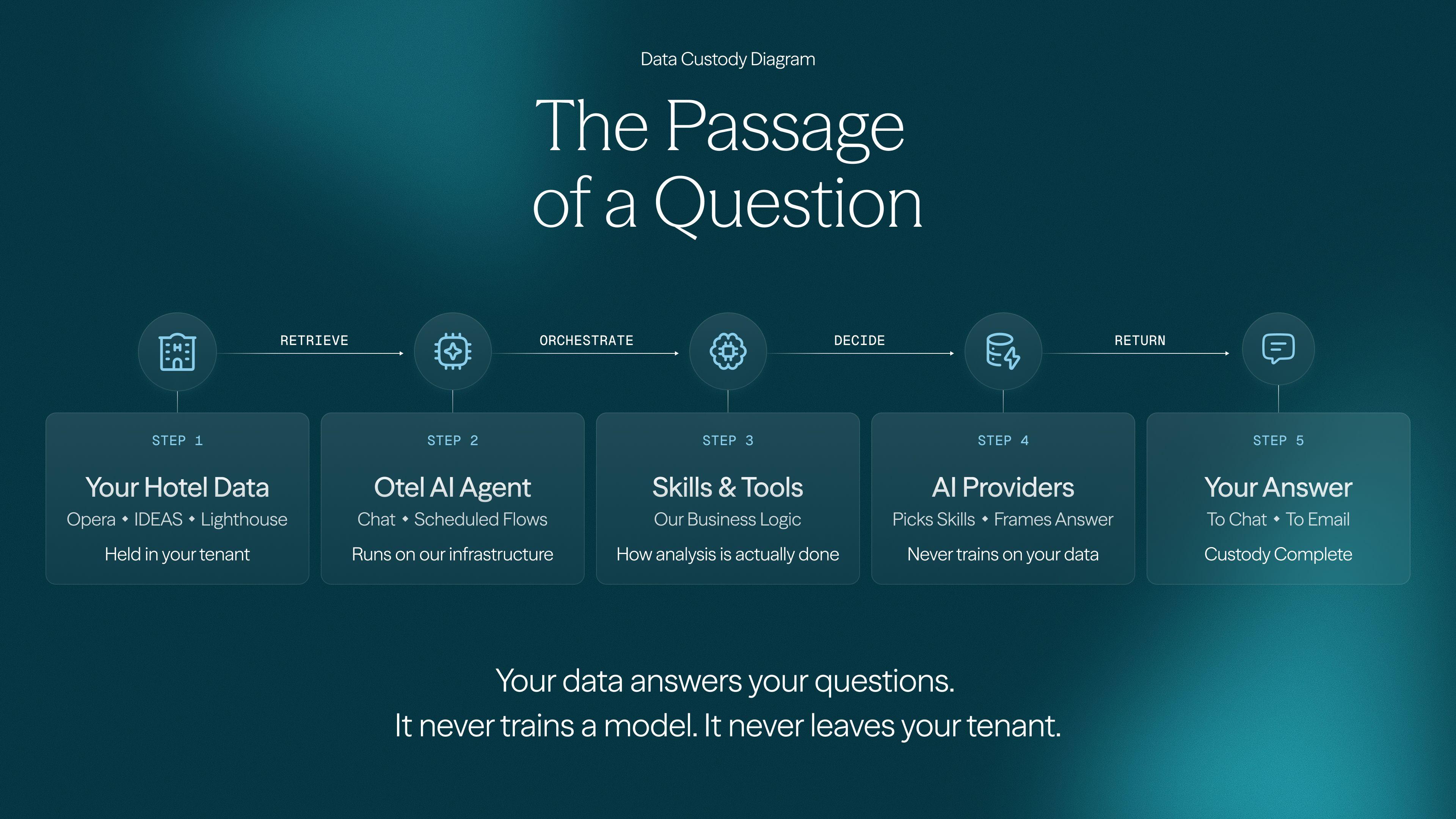
How Otel AI uses AI — securely.
An overview for IT, cybersecurity, and procurement teams: how Otel AI handles your hotel's data, where it lives, and why it's never used to train AI models.
 Nikhil Patil·21 Apr 2026