
Can AI find your hotel? Four questions to answer before your guests ask
Guests now ask ChatGPT, Gemini and Google's AI Mode for a hotel and get a shortlist. Four questions to check whether AI can read, trust and book you.

More guests now start a trip by asking ChatGPT, Gemini or Google's AI Mode for a hotel. They get a shortlist, not ten blue links, and a hotel that isn't on it never gets compared. On 3 November, Booking Holdings said AI chat referrals were growing, though still well under 1% of Booking.com's room nights.
Nobody outside OpenAI or Google knows exactly why one hotel gets named over another. What we do know is how these tools read the web, where they take their facts from, and how bookings flow back to hotels. That is enough to act on.
The habit is already changing search. On Google, people click a normal result about half as often when an AI summary appears: 8% of visits against 15%, in a 2025 Pew study of US Google users. With AI bookings still small, now is the cheap time to get the basics right.
We break the work into four questions. Start with the first: nothing else counts if AI can't read the page.
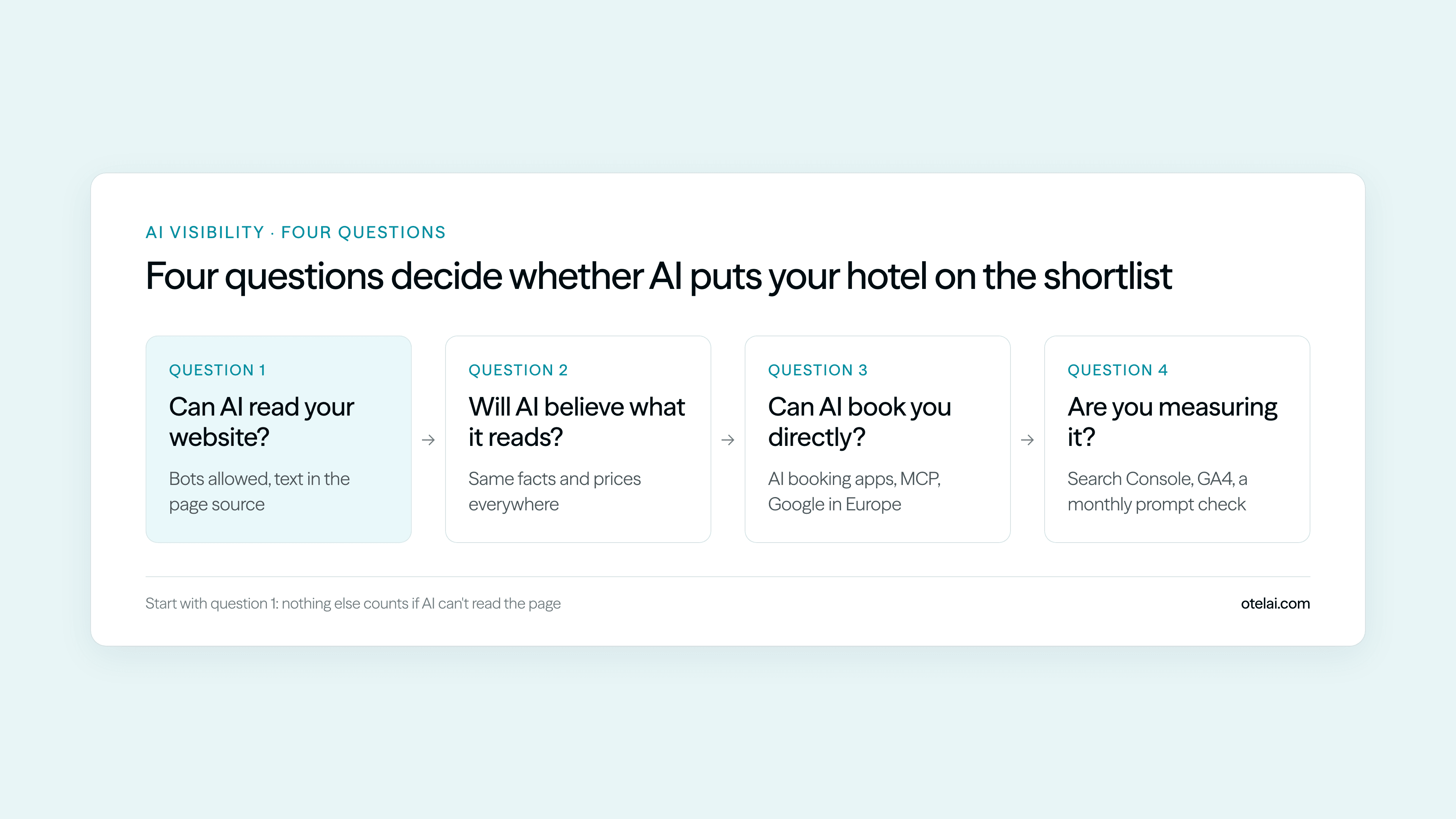
1. Can AI read your website?
AI can read your website when its crawler is let in and your key facts are in the page itself, not loaded later by JavaScript. Three things often get in the way.
Your robots.txt file or firewall. Most AI companies run separate bots for search and for training, so you can block training and still appear in answers. Allow these in robots.txt and in your firewall settings. The “-User” bots fetch pages on a guest’s behalf and may skip robots.txt, so your firewall is what can actually block them.
| Where guests ask | Bots to allow |
|---|---|
| ChatGPT | OAI-SearchBot, ChatGPT-User |
| Claude | Claude-SearchBot, Claude-User |
| Perplexity | PerplexityBot, Perplexity-User |
| Google AI Overviews and AI Mode | Googlebot |
| Microsoft Copilot | Bingbot |
Where guests ask
ChatGPT
Bots to allow
OAI-SearchBot, ChatGPT-User
Where guests ask
Claude
Bots to allow
Claude-SearchBot, Claude-User
Where guests ask
Perplexity
Bots to allow
PerplexityBot, Perplexity-User
Where guests ask
Google AI Overviews and AI Mode
Bots to allow
Googlebot
Where guests ask
Microsoft Copilot
Bots to allow
Bingbot
Blocking the training bots, GPTBot and ClaudeBot, doesn't stop you appearing in answers. Google-Extended doesn't affect Google Search.
Your CDN settings. Since July 2025, Cloudflare has blocked known AI crawlers by default on new sites. Ask whoever runs your website to check what is allowed.
JavaScript. The major AI crawlers, including OpenAI's, Anthropic's and Perplexity's, don't run JavaScript. Google does. If your room types, policies or rates only load inside a booking widget, ChatGPT, Claude and Perplexity see a blank.
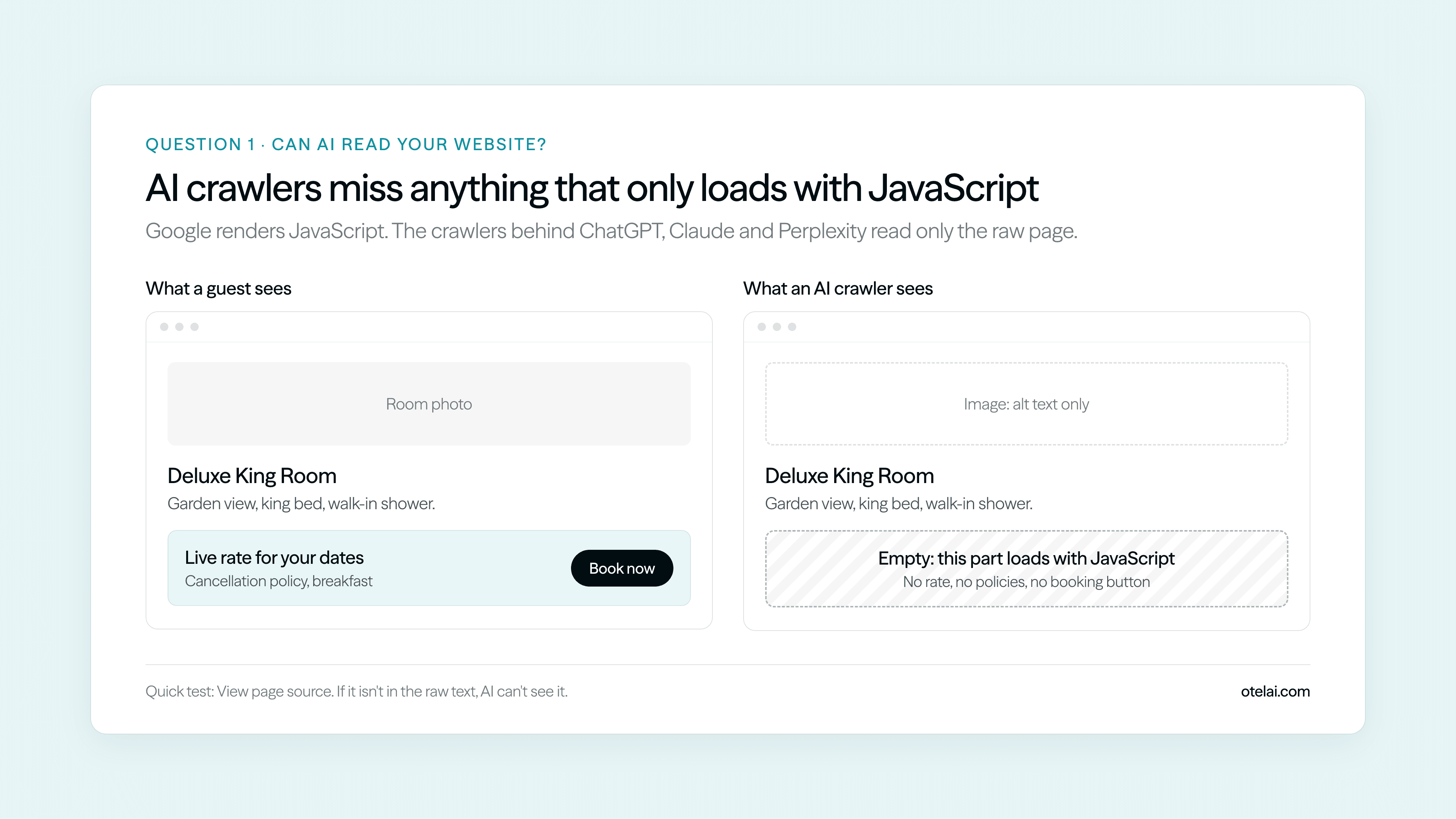
Quick test: open a room page and choose "View page source". If the room description, check-in time or parking details aren't in that raw text, an AI crawler can't see them either.
Check your key pages are indexed in Google and Bing too. Google says its AI features use the same index and ranking systems as normal search.
2. Will AI believe what it reads about you?
AI trusts the version of your facts it sees most often, and for many hotels that's your OTA listings, not your own website. In Cloudbeds' 2025 study of ChatGPT, Perplexity and Gemini across six destinations, more than half of the sources cited for hotel recommendations were OTAs. Hotel websites were 13.6%. Brand-affiliated hotels took 72.4% of the recommendations, which makes the job harder for independents.
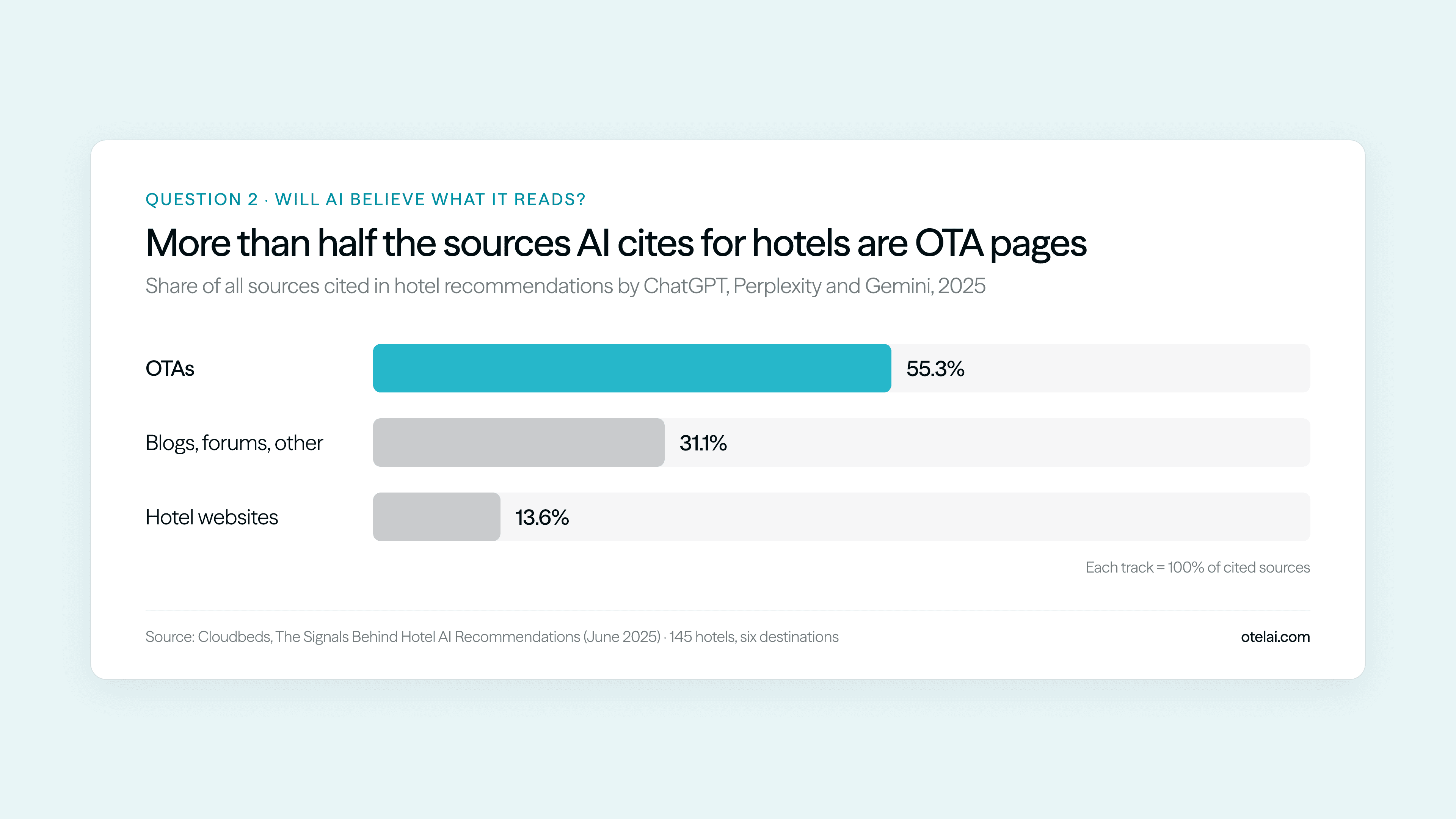
When your facts disagree across sources, an AI has no reason to trust your version over Booking.com's. What to do:
- Make your facts match everywhere. Room types, amenities, fees, policies and check-in times should match on your website, Google Business Profile, every OTA and Tripadvisor. Start with the OTAs, because they are read most.
- Keep your prices accurate. Google filters out hotel prices it finds inaccurate, in ads and free booking links. If an OTA shows a lower or wrong rate, that is the number that gets repeated, so parity on your busy nights is now a visibility problem as well as a revenue one.
- Treat reviews as your description. Every hotel recommended in the Cloudbeds study had plenty of positive reviews across Tripadvisor, Google and the OTAs. Fix the cause, not just the reply: a slow check-in guests keep mentioning is likely to surface in the answer.
- Answer real guest questions in plain text. Parking, early check-in, distances, accessibility and room differences belong on the page, not in a PDF or image. You don't need to rewrite your site into FAQs; Google says that isn't needed.
- Earn mentions elsewhere. Across 75,000 brands, Ahrefs found mentions on other websites tracked AI Overview visibility far more closely than backlinks. Correlation, not proof, but local press, tourism boards and "best hotels in" guides are worth pitching.
3. Can AI book you directly?
Where the apps are available, yes: guests can see live rates inside ChatGPT and Claude, then finish the booking on the hotel's own website. Booking.com and Expedia launched apps inside ChatGPT in October 2025, at first for users outside the EU. Since then Accor, Wyndham and IHG have added their own, and Accor is also in Claude.
For independents, the bigger change is direct-booking apps inside ChatGPT and Claude, run by hotel tech providers, from booking engines to rate and distribution platforms. They show your own content and live rates, then send the guest to your website to book, often on a flat fee or a lower commission than an OTA. Two questions for your provider:
- Do you connect our rates to any of the AI apps today, and at what cost?
- Do you support MCP, the standard that lets AI tools read live availability and rates, and in some cases book?
In the US, Google now lets guests book hotels inside AI Mode, through ten launch partners: the big OTAs and large chains.
The EU looks different. In early September, after the EU's Digital Markets Act ruling, Google removed live prices from the hotel box in EU search results. Your rate still appears on Google Maps and Google Hotels, and hotel ads now need rates fed from your own Hotel Center account or a connectivity partner. These rules cover searches from the EU, and the UK isn't bound by them, so the same hotel can look different to a guest searching from Dublin and one searching from London.
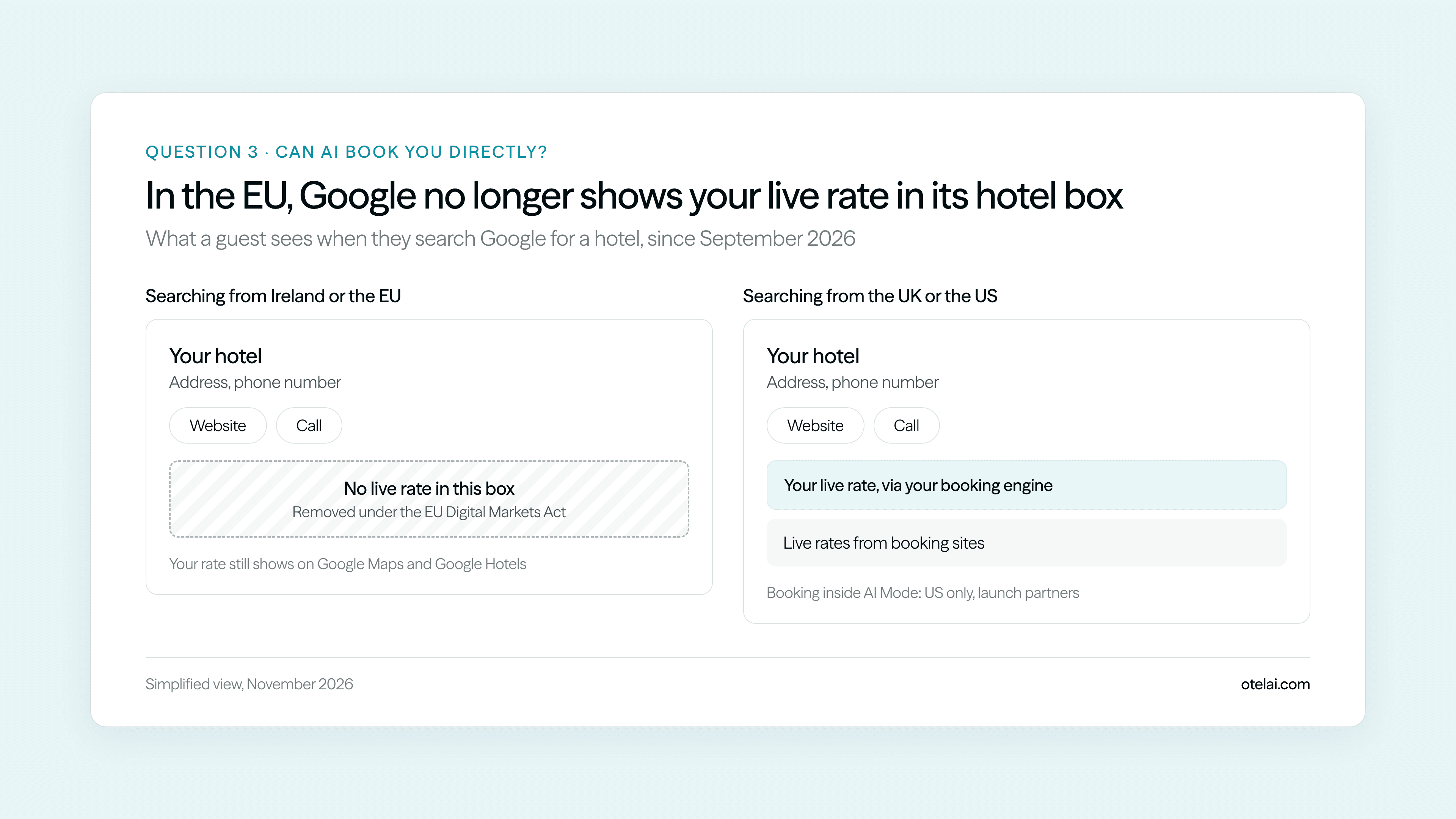
Google also ended self-service rate entry in Business Profile in July 2025, so showing prices needs a booking engine, CRS or channel manager connected to Google.
4. Are you measuring it?
You can measure most of it for free, though no single tool covers every engine, so use these together.
- Google Search Console now has a generative AI section showing how often your pages appear in AI Overviews and AI Mode. It counts impressions, not clicks. If you see Google's switch to opt out of AI features, don't turn it on: opting out means no impressions or traffic from them.
- Google Analytics 4 added an "AI Assistant" channel in May that groups visits from ChatGPT, Gemini and Claude. Visits from the AI apps often arrive with no referrer and land in Direct, so treat the figure as a floor.
- Bing Webmaster Tools shows how often Microsoft Copilot cites your pages.
- A monthly prompt check. Once a month, ask ChatGPT, Gemini and Perplexity 10 to 20 questions your guests actually ask, such as "dog-friendly hotel near the city centre with parking". Note who gets named, what is said about you, and what is wrong.
What isn't proven
Be wary of anyone selling certainty. Google doesn't use llms.txt files, and no major AI system has confirmed it reads them. Schema markup helps search engines understand your pages, but Google says its AI features need no special markup. And none of the published studies test what changes one hotel's recommendations. Most of this is good hotel SEO and good distribution habits, done consistently.
Your checklist for this month
- Allow the AI search bots in robots.txt and in your CDN settings.
- Check the page source of your top five pages.
- Line up your facts across your website, Google and your top three OTAs.
- Check rate parity on your busiest nights.
- Ask your booking engine about AI booking apps and MCP.
- Open the AI section in Search Console and the AI Assistant channel in GA4.
- Run your first 20-question prompt check.
Some of these need watching every week, not once, which is why it's worth a line in your 2027 AI budget. That routine watching is what Otel does for hotel teams, on top of the systems they already run: flagging rate parity gaps and competitor price moves, and pulling the themes out of your reviews so your team can fix the cause.
Sources
- Cloudbeds, The Signals Behind Hotel AI Recommendations (June 2025)
- PhocusWire, Booking Holdings Q3 2026 earnings (3 November 2026)
- Pew Research Center, Google users are less likely to click on links when an AI summary appears (July 2025)
- Vercel and MERJ, The rise of the AI crawler
- Anthropic, Claude's web crawlers
- Ahrefs, AI Overview brand visibility factors, 75,000 brands (May 2025)
- Hospitality Net, In Europe, Google's hotel unit now shows everything except the rate (September 2026)
- TechCrunch, Google's AI Mode can now help book hotels (27 August 2026)
- Google Search Central, Generative AI performance reports in Search Console (3 June 2026)
- Google Hotel Center, Self-service hotel rates ending 30 July 2025
Continue reading
Related articles

AI Risks in Hotels: What Can Go Wrong, and What Good AI Looks Like
An honest look at the real risks of AI in hotel operations, from black-box pricing to alert fatigue, and what traceable, human-in-the-loop AI should look like.
 Paul Ryan·21 Jul 2026

Where Agentic AI is Actually Earning its ROI in Hotels
Not guest chatbots. Not autonomy for its own sake. Otel's Paul Ryan on where agentic AI is quietly earning its ROI in hotels right now.
Paul Ryan·15 Jul 2026
What I Saw at HITEC 2026 That Nobody Else Is Talking About
Most startups at HITEC were building guest-facing AI. The problem eating the first two hours of every GM's morning went almost unaddressed. Here's what Otel AI CEO Paul Ryan saw.
Paul Ryan·2 Jul 2026